
Choosing the wrong level of care is one of the most common mistakes families make.
ElderCare Placement Advisors conducts a clinical and lifestyle assessment before recommending options.
The right decision today prevents regret tomorrow.
If you are searching for:
Assisted living vs adult family home in King County
Difference between assisted living and adult family home in Snohomish County
Best dementia care option near Seattle
Small residential care home near Everett
You are likely trying to make the right decision before a crisis forces one.
Both assisted living communities and adult family homes provide care and housing. The right choice depends on medical needs, cognitive status, personality, and financial sustainability in the Puget Sound market.
What Is Assisted Living in King & Snohomish County?
Assisted living communities in King County (Seattle, Bellevue, Kirkland, Renton, Sammamish, Issaquah, Woodinville, Bothell, Redmond, Mercer Island) and Snohomish County (Everett, Lynnwood, Edmonds) are typically larger residential settings with:
40 to 150+ residents
Private or semi-private apartments
Dining rooms and structured activities
Scheduled transportation
Tiered care based on Activities of Daily Living (ADL)
Many also offer dedicated memory care wings for residents with dementia.
Assisted living is often appropriate for seniors who:
Benefit from social interaction
Need moderate ADL assistance
Have lower medical complexity
Desire private apartment living
Do not require intensive behavioral management
What Is an Adult Family Home in Washington State?
Washington State licenses adult family homes as small residential care settings, typically serving 4 to 6 (can be up to 8) residents.
King and Snohomish Counties have one of the highest concentrations of licensed adult family homes in the country.
They provide:
Private or shared bedrooms
24 hour caregiver presence
Higher caregiver-to-resident ratios
Home-style environment
Often more flexibility with higher acuity residents
Adult family homes are frequently chosen for:
Advanced dementia
Two-person transfers
Higher medical needs
Behavioral challenges
Seniors who struggle in large, stimulating environments
Families seeking consistent caregivers
Side-by-Side Comparison: King & Snohomish County
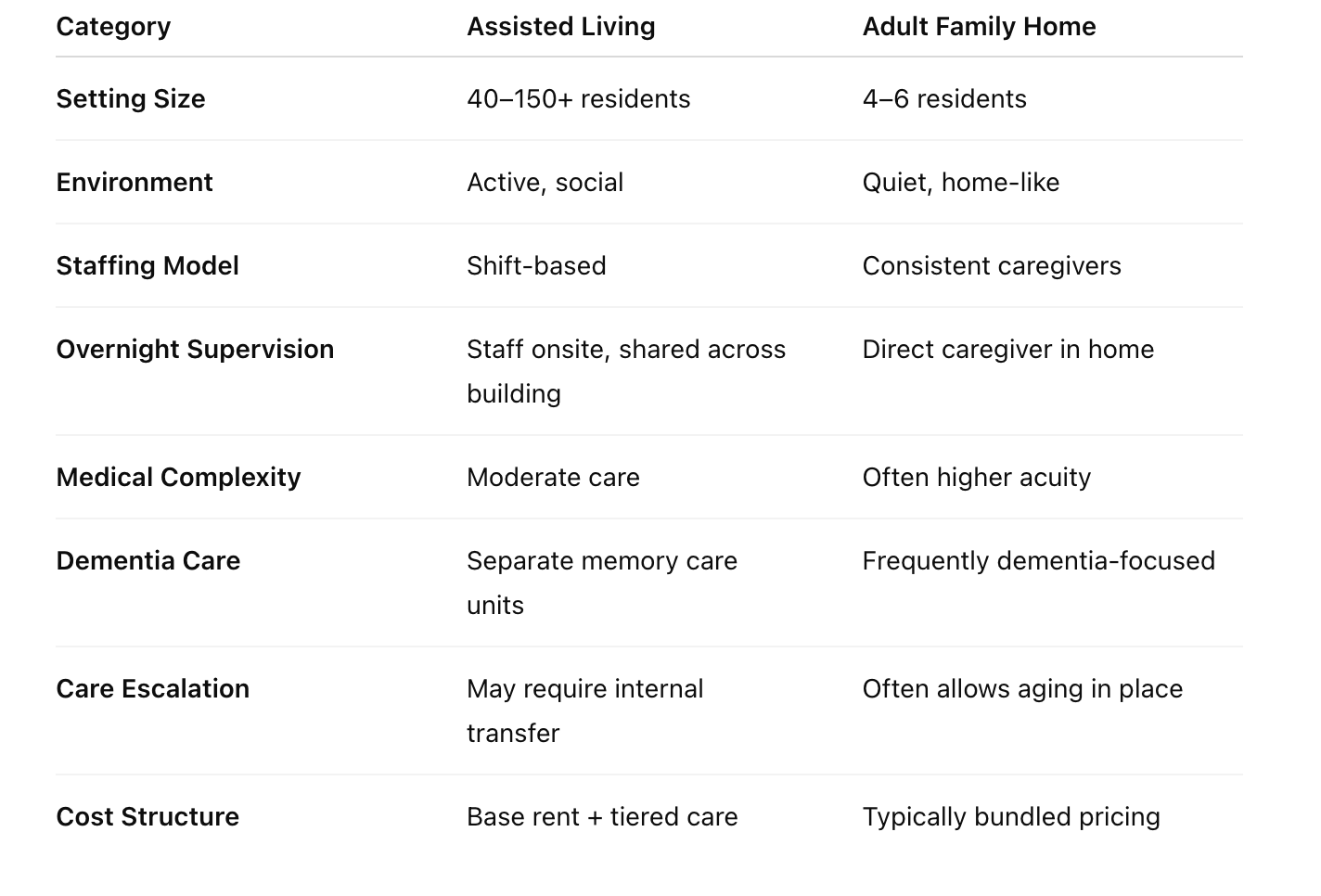
Cost of Assisted Living in King & Snohomish County
Costs in Western Washington are higher than national averages due to housing and labor expenses.
Assisted Living Costs (Estimate only)
King County:
Base rent: $4,500 to $6,500 per month
With care services: $5,500 to $8,500+ per month
Memory care: $6,500 to $9,500+ per month
Snohomish County:
Base rent: $4,000 to $5,500 per month
With care services: $5,000 to $7,500 per month
Memory care: $6,000 to $8,500+ per month
Pricing depends on:
Level of ADL assistance
Medication complexity
Two-person transfers
Behavioral supervision
Private vs shared apartment
Cost of Adult Family Homes in King & Snohomish County
Adult family home pricing is typically based on care intensity rather than base rent.
Adult Family Home Costs
King County:
$6,000 to $10,000 per month
Higher-end dementia or high medical acuity homes may exceed $10,000
Snohomish County:
$5,500 to $8,500 per month
Advanced dementia homes may approach $9,000+
Unlike assisted living, many adult family homes bundle care services into a single monthly fee.
For higher-acuity residents, adult family homes may be cost-competitive with memory care units in larger communities.
Dementia Care: Which Is Better in Western Washington?
Families often search:
Best dementia care in Seattle
Adult family home for advanced dementia near me
Memory care vs adult family home Washington
Early-stage dementia may do well in assisted living with cognitive support.
Advanced dementia with wandering, agitation, or behavioral symptoms often benefits from:
Smaller environment
Consistent caregivers
Lower stimulation
Direct supervision
In King and Snohomish Counties, many adult family homes specialize specifically in dementia care.
Progression Planning: Think 24–36 Months Ahead
The key question is not just where your parent or spouse fits today.
It is whether the setting can safely support them if:
Mobility declines
Dementia progresses
Hospitalizations increase
Behavioral symptoms escalate
In assisted living, increasing care needs may trigger higher care tiers or a move into memory care.
In adult family homes, residents often age in place with increasing support.
Multiple relocations can accelerate cognitive decline. Planning for progression reduces risk.
Medicaid Considerations in Washington State
Washington State offers Medicaid long-term care programs that may help cover adult family homes and certain assisted living settings after private funds are spent down.
However:
Not all communities accept Medicaid
Availability may be limited
Planning ahead is critical
Selling a home is not automatically required, but asset and income rules apply.
Understanding these rules before crisis prevents rushed financial decisions.
Which Option Is Right for Your Family?
There is no universal answer.
The right decision depends on:
Clinical needs
Dementia stage
Personality
Caregiver consistency needs
Budget sustainability
Long-term progression outlook
Families in King and Snohomish Counties often feel overwhelmed by the number of choices.
At ElderCare Placement Advisors, we conduct structured care assessments and match families with memory care, assisted living and adult family homes that align with both medical needs and financial reality in the local market.
If you are comparing options and unsure where to begin, that is normal.
The right placement is clearer when evaluated systematically.
You do not have to navigate this alone.